
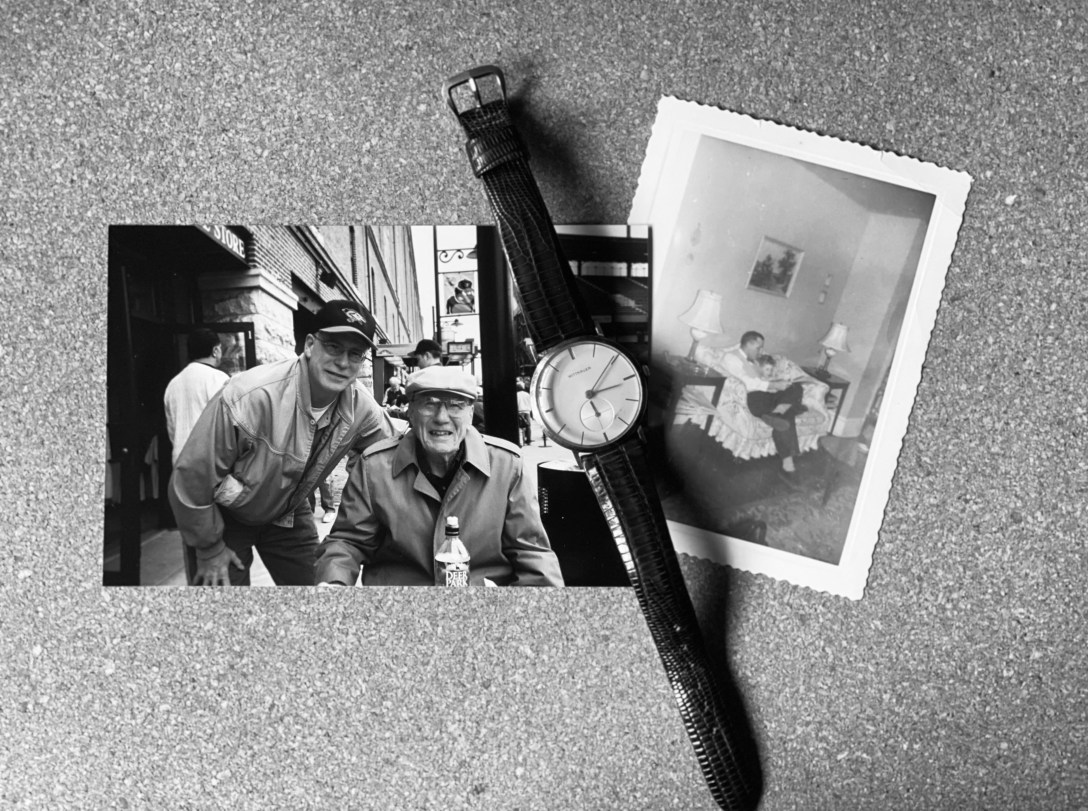
I opened the middle drawer of my desk recently and noticed my father’s watch. Shortly before his death in 2009, with his permission, I assumed ownership. I reached for it, wound it to see the tiny second hand rotate once again, very slowly. I re-read the inscription on the back: Frigidaire Best Seller, Summer, 1956.
My dad’s entire civilian working career was with the Potomac Edison Power Company which, in 1956, also sold appliances. The brand name Frigidaire captured the minds of those in need of refrigerators. In the 1950’s, Frigidaire was to refrigerators as Xerox is now to copy machines. Dad apparently helped meet the new-Fridge needs of many customers the summer of ’56.
I didn’t realize it when I grabbed the watch, but now it helps me remember my father, the successful work he did, and the blessing I’ve had to be his son. My friends in the grief and loss field call such possessions: transitional objects.
Items which previously belonged to a deceased loved one not only bring memories, but serve as symbols of love in the midst of longing. Yes, it is natural to miss loved ones over long periods of time and so it is important to find meaningful ways to continue to mourn their loss.
In my work with the bereaved I have heard and seen many creative ways for loved ones to use transitional objects. They are very helpful for parents who have lost children. Special toys, clothes and blankets are considered priceless. Even for adults, possessions of a beloved family member can hold incredible meaning. My wife kept her father’s flannel shirts and had the fabric sewn into teddy bears made for numerous members of the family. The sweatshirt of a deceased loved one which is now worn by the bereaved person gives the sense of a warm hug.
I have also encountered folks who worry that the use of transitional objects are signs that the bereaved person is not “moving on” and considered the behavior a mental health concern. I’ve learned that the key test for this is to consider the bereaved person’s full life…has the person avoided a return to work and/or relationships with others? Is the person constantly sad and avoiding experiences which they previously enjoyed? If the answers to these questions are yes, then the person may be dealing with complicated mourning and a referral to a grief therapist may be appropriate.
My experience, however, is that most bereaved people use transitional objects for integrating the deceased into their lives in meaningful ways. A father whose teenage son died from an asthma attack kept many small memorabilia items such as tickets to sporting events and movies they attended together, his signature drum sticks, and a head band he constantly wore. The father enjoyed wood working and worked for months on a hand-crafted box to hold these items. Selecting these special items and using his hands to create the box were excellent ways for the father to mourn.
We don’t need reminders of the many pandemic losses we will continue to experience. However, I hope all who mourn may remember the importance of watching for ways to reconcile their losses. Transitional objects may be a means of providing comfort in these difficult times. May you, and those you love, be “At Peace.”
 At Peace
This story seemed written just for me as I have Jim’s watch, my mother’s watch, and my grandmother’s watch locket she wore on a gold chain around her neck. I don’t think my grandkids even know what a watch is!! Somebody else will have to dispose of them as I surely can’t! I am smiling as I write this note to you.
Thanks, Robin.
Emily Washington
LikeLike
Hi Robin,
Hope all is well. I particularly liked this piece and we would like to post it on our DF Facebook page with your permission. With my mother’s recent death this article was particularly timely for me.
Pam
LikeLike
It’s hard to know what the meaningful things are Vs just trying to hold on to everything, great post
LikeLike